Health Insights for Better Care at Home
Trusted advice, preventive tips, and practical guidance – helping you make informed healthcare decisions for your family.
Why Early Treatment at Home Can Prevent Unnecessary Hospitalisation
When people feel unwell, many choose to “wait and watch.” They hope the illness will improve on its own.
Unfortunately, this delay is one of the most common reasons patients eventually require hospitalisation.
Over years of caring for patients in Thane and nearby areas, we’ve noticed a consistent pattern:
Hospitalisation is often not necessary because the illness is severe—it becomes necessary because treatment starts too late.
The Importance of Early Medical Care
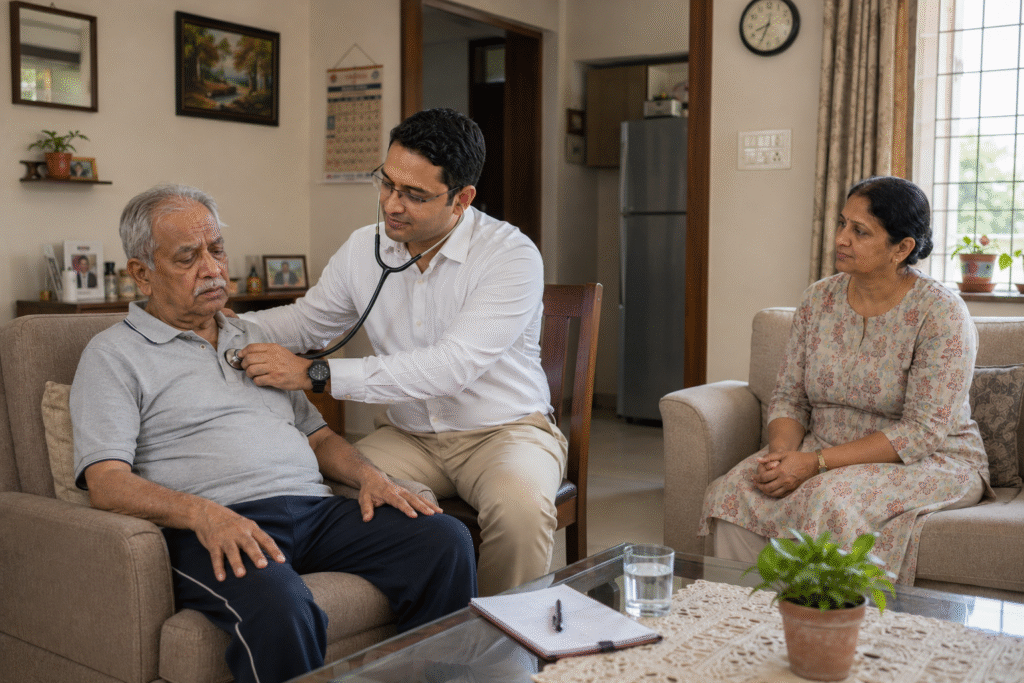
When symptoms are identified early, many medical conditions can be managed safely at home with:
- Proper medical examination
- Correct medications
- Regular follow-up
- Close monitoring
- Timely investigations when needed
This approach often helps patients recover comfortably while avoiding unnecessary hospital admissions.
But Home Treatment Doesn’t Mean Avoiding the Hospital
Home care isn’t about keeping every patient out of the hospital.
It’s about making the right decision at the right time.
If a patient requires hospital admission, early medical assessment helps identify that need quickly—before the condition worsens.
Benefits of Home Visits
- Early diagnosis
- Treatment starts immediately
- Continuous monitoring
- Direct communication with family
- Timely referral to hospital whenever necessary
Every Patient is Different
Some illnesses improve with treatment at home.
Others require hospital care.
The key is identifying which path is appropriate as early as possible.
Our Goal
Our goal is simple:
Provide timely medical care in the comfort of your home while ensuring patients receive hospital treatment promptly whenever it is truly needed.
Early treatment saves time, reduces complications, and gives patients the best chance of recovery.
Need a doctor to visit your home in Thane or nearby areas? Contact DocVisit today.
Don’t Choose the Fastest Doctor. Choose the Right Doctor for a Home Visit.
When a family member suddenly falls ill, especially an elderly parent, one of the first questions people often ask is:
“How soon can the doctor come?”
Timely medical attention is important, but when arranging a doctor home visit, speed should not be the only factor you consider.
We have become used to instant services. Food, groceries, medicines and other deliveries can often reach us within minutes. But healthcare is different.
When choosing a doctor, it is worth taking a little time to understand who is coming to treat your family member and how they approach patient care.
What Should You Check Before Booking a Home Visit Doctor?
Before choosing a doctor for a home visit, consider:
Who is the doctor?
Know the doctor’s name, qualification, registration and clinical experience.
Are there genuine patient reviews?
Read what previous patients and families say about their experience—not just the star rating, but comments about the doctor’s approach, examination, treatment and follow-up.
Will the patient receive a proper assessment?
A home visit should involve understanding the patient’s medical history, existing illnesses, medications and current symptoms, along with an appropriate clinical examination.
Is the focus only on immediate relief?
A patient may feel better temporarily, but that does not always mean the overall medical condition has been properly assessed. Especially in elderly patients, understanding the bigger picture is important.
Is follow-up available when required?
For elderly patients and those with ongoing medical conditions, follow-up and monitoring can be an important part of care.
Temporary Relief Is Not Always the Whole Picture
Sometimes a patient feels better after receiving immediate treatment, and that is certainly reassuring.
However, temporary relief and a complete medical assessment are not necessarily the same thing.
Elderly patients may have multiple medical conditions and may already be taking several medications. Their symptoms can sometimes be related to an underlying problem that requires a more detailed assessment.
The purpose of a doctor home visit should therefore go beyond simply addressing the immediate complaint. It should involve understanding the patient, conducting an appropriate examination, deciding on suitable treatment and advising the family about what to monitor and what to do next.
Does the Doctor Have to Arrive Immediately?
We are increasingly accustomed to instant services, and this expectation has also started to affect healthcare.
But doctors don’t operate like delivery services.
A doctor may already be examining another patient, completing a consultation, travelling between home visits or attending to another patient’s medical needs.
In a non-emergency situation, waiting a little longer for a doctor you have chosen carefully can be reasonable.
This does not mean that emergencies should wait. If a patient has signs of a medical emergency, appropriate emergency medical care should be sought without delay.
The point is simple: for a non-emergency home consultation, the fastest available doctor should not automatically be the only consideration.
Especially When the Patient Is Elderly
Choosing the right doctor becomes even more important when arranging a home visit for an elderly parent or family member.
Older adults may have several health conditions at the same time and may find travelling to a clinic difficult because of age, weakness or limited mobility.
A home visit makes medical care more accessible, but the quality of the consultation still matters.
Look for a doctor who takes the time to understand the patient’s condition, performs an appropriate examination, explains the situation clearly and provides follow-up when required.
We Research Everything Else. Why Not Our Doctor?
Before buying a phone, appliance or even a small product online, we often:
Compare → Read reviews → Check details → Make a decision.
Choosing a doctor deserves at least the same level of consideration.
When it comes to your health or the health of your elderly parents, don’t choose solely on the basis of:
“Who can come first?”
Instead, ask:
Who is the doctor?
What is their experience?
What do genuine patients say?
How will the patient be assessed?
What happens after the visit?
Don’t Ask Only, “How Soon Can the Doctor Come?”
The next time you need a doctor home visit, remember:
Don’t choose the fastest doctor. Choose the right doctor for the patient.
Availability matters. But experience, genuine patient feedback, proper assessment, appropriate treatment and follow-up matter too.
At DocVisit, we provide doctor home visits for patients who may find it difficult to travel to a clinic, with a particular focus on making medical care accessible to elderly and mobility-limited patients.
Because healthcare isn’t instant delivery. It is about providing the right care to the right patient at the right time.